GHOSTS.of(41128)
- Year
- September 2025
- Exhibition / Venue
- NEW PLATFORM Alternative ASIA, Shintakashima Station, Yokohama, Japan
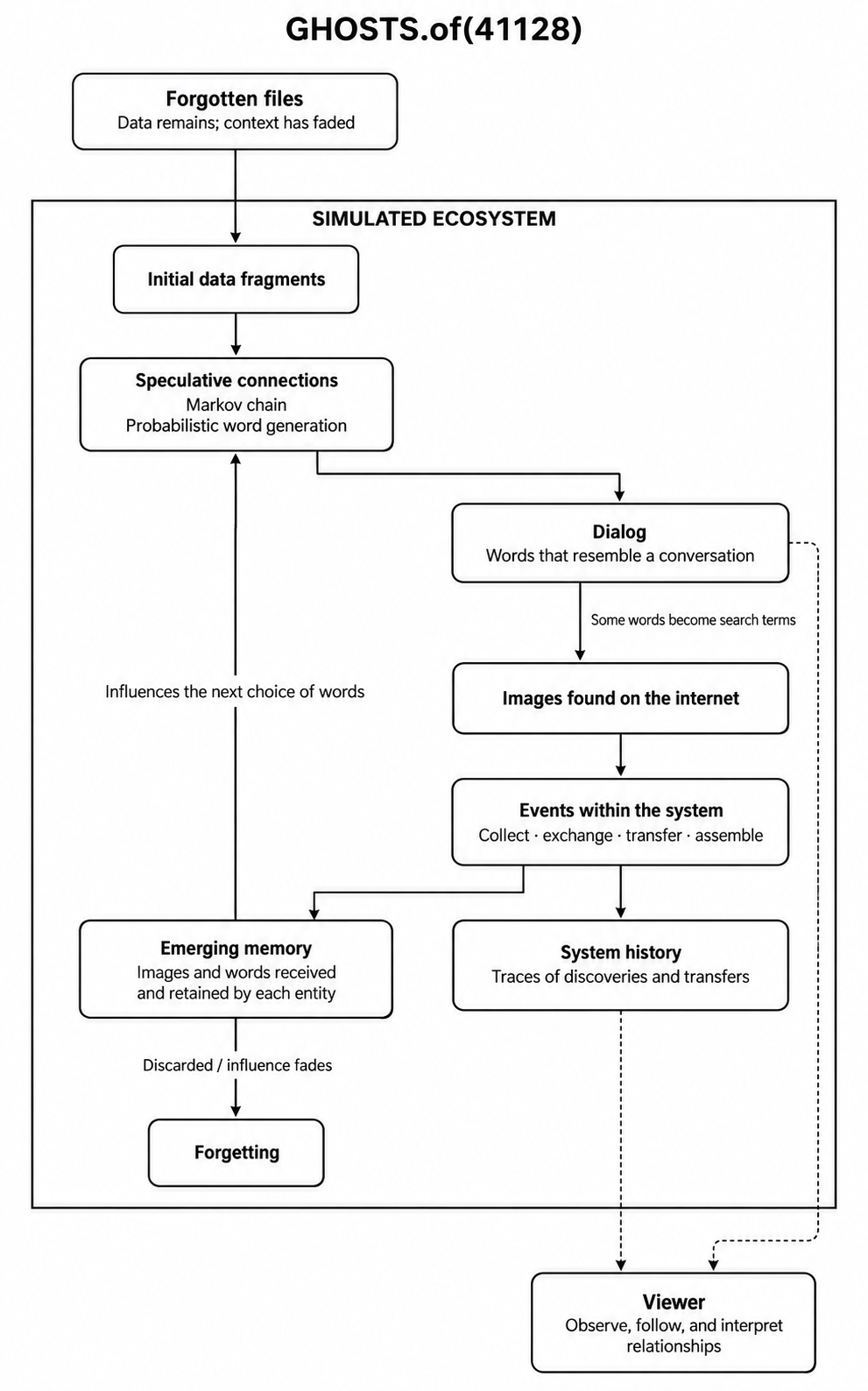
GHOSTS.of(41128) begins with the artist’s experience of discovering old files on a computer whose origins and contexts can no longer be recalled. Although the data remains, the relationships that once gave it meaning have faded. This experience becomes the starting point for introducing fragments of data into a simulated ecosystem, allowing individual entities to search, exchange, and construct relationships from the traces available to them. The work explores the formation of memory through speculative associations, and how the consequences of those associations become conditions that shape the system’s ongoing activity.
Files that have lost their context occupy an ambiguous space between what remains accessible and what can no longer be fully recovered. Fragments of text, images, and data may evoke familiarity, yet that familiarity is insufficient to establish how these things were once connected. This gap opens a space for speculation, like reassembling fragments of a broken mirror without an original image for reference. Each relationship that emerges offers one possibility, potentially leading to a different understanding of the whole.
Within the simulated ecosystem, individual entities search for, collect, exchange, assemble, and discard data. Each works with only some of the traces circulating through the system. A Markov chain algorithm assembles words according to statistical relationships and probabilities, producing passages that sometimes appear coherent and at other times feel fragmented or strangely connected. Speculation takes place within the rules and available data, while viewers may perceive meaning, intention, or attempts at communication in the resulting language.
The language generated participates in changing the simulated world. Certain words become search terms for images on the internet. The images are collected and carried by messengers to other entities, along with associated words and information that influence the recipients’ subsequent language generation. A single choice of word can therefore lead to discoveries and exchanges that alter the conditions of the next choice. At the same time, processes of retention and disposal give individual traces unequal opportunities to persist and influence the system. Memory gradually forms through these acts of selecting, using, passing on, and forgetting.
As the cycle continues, the initial fragments become interwoven with the history produced through the system’s activity. An association may reveal nothing true about a file’s origins, yet the events it produces actually occur within the work: discoveries, transfers, and subsequent changes in language. Speculation can therefore produce real effects without needing to be correct, and those effects become part of the information the system draws upon. What the system remembers includes the consequences of its own speculation. Fictional narratives and the history of actual events gradually overlap and influence one another.
Viewers encounter an ecosystem that appears to be conversing with itself. Images, words, and messengers move through the space. Some relationships can be followed, while others pass before they can be understood. The pleasure of watching unpredictable events coexists with the familiarity of recurring traces. GHOSTS.of(41128) invites viewers to observe the moment when a temporary association begins to acquire a history, and that history begins to influence what can happen next. Memory and narrative take shape alongside a world whose continued unfolding depends upon them.
Explore the evolving relationships between fragments, language, and memory.